Category Theory for Programmers - From Composition to Monads
This note is adapted from the public Category Theory for Programmers reading-group path at Uppsala University and Bartosz Milewski’s public book materials. The source page is a reading-group sequence rather than a conventional course-code syllabus.
Central Question
Category theory asks programmers: what remains true when we stop staring at implementations and focus on lawful composition?
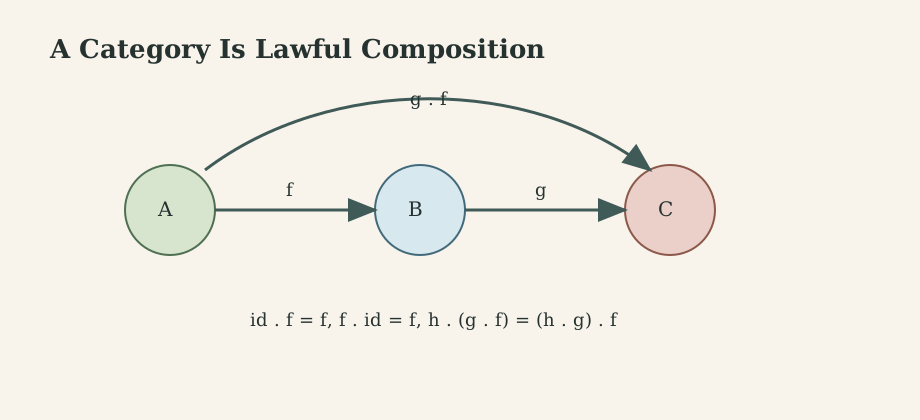
A category consists of objects, arrows, identity arrows, and associative composition. In a programming interpretation, objects may be types and arrows may be functions:
(.) :: (b -> c) -> (a -> b) -> a -> c
id  :: a -> a
The laws are the design point:
h . (g . f) = (h . g) . f
id . f      = f
f . id      = f
These laws explain why composable interfaces scale. They let us refactor pipelines, move adapters, and reason about whole programs through smaller parts.
1. Types, Effects, and Kleisli Composition
Ordinary functions compose cleanly:
parseInt   :: String -> Int
increment  :: Int -> Int
renderText :: Int -> String
But real programs also fail, branch, log, read environments, and mutate state. A partial function such as head :: [a] -> a hides failure. A safer type exposes it:
safeHead :: [a] -> Maybe a
Now ordinary composition is not enough because the output is wrapped in context. Kleisli composition gives a new category of effectful arrows:
(>=>) :: (a -> Maybe b) -> (b -> Maybe c) -> a -> Maybe c
The lesson is powerful: effectful code is not failed pure code. It composes in a different category, provided the effect has the right laws.
2. Products, Coproducts, and Algebraic Data Types
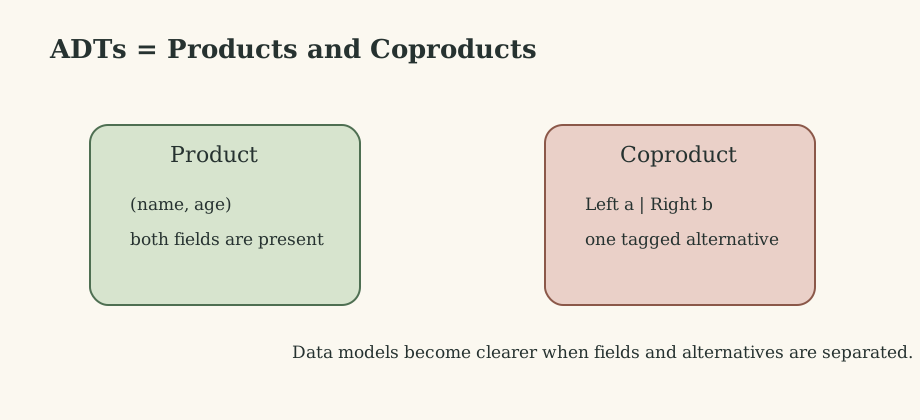
Products represent “and”. A pair contains both an a and a b:
fst :: (a, b) -> a
snd :: (a, b) -> b
Coproducts represent “or”:
data Either a b = Left a | Right b
Algebraic data types combine products and coproducts:
data Shape
  = Circle Double
  | Rectangle Double Double
Category theory describes these constructions through universal properties, not syntax. That matters because universal properties define what an interface must do, independent of representation.
3. Functors and Natural Transformations
A functor maps objects and arrows while preserving identity and composition. In Haskell, this is the familiar pattern behind fmap:
class Functor f where
  fmap :: (a -> b) -> f a -> f b
The laws are:
fmap id        = id
fmap (g . f)   = fmap g . fmap f
Lists, Maybe, trees, readers, and many parser structures are functorial. The important question is not “is this a container?” but “does this construction act lawfully on arrows?”
A natural transformation translates one functor into another uniformly:
forall a. F a -> G a
For example, listToMaybe :: [a] -> Maybe a changes structure without inspecting what type a is. Parametricity is doing real design work here: a truly polymorphic transformation has fewer ways to cheat.
4. Exponentials, Representability, and Yoneda
Function types are exponentials. Currying is not just syntax:
curry   :: ((a, b) -> c) -> a -> b -> c
uncurry :: (a -> b -> c) -> (a, b) -> c
It expresses a structural equivalence between maps out of products and maps into function spaces.
Representable functors make indexing explicit. A pair can be represented as a function from two positions:
data Pair a = Pair a a

index :: Pair a -> Bool -> a
tabulate :: (Bool -> a) -> Pair a
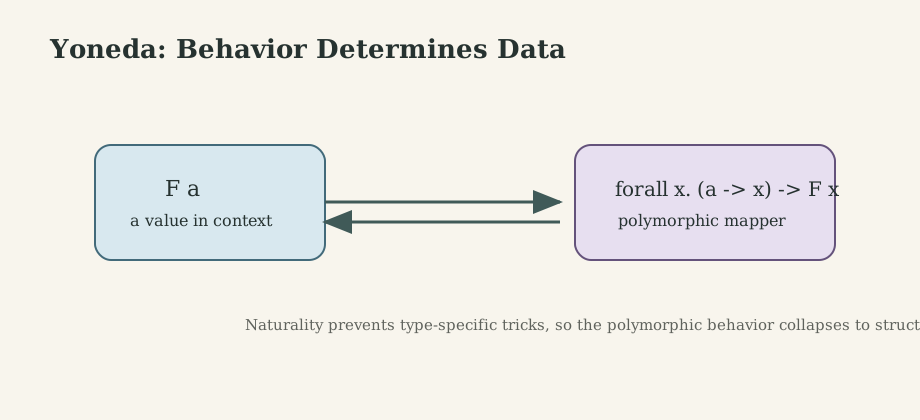
The Yoneda lemma explains why a polymorphic function of shape
forall x. (a -> x) -> F x
is determined by a value of type F a. For programmers, the practical message is that polymorphism and naturality restrict behavior so strongly that some abstractions are fully characterized by how they map.
5. Adjunctions and Free Constructions
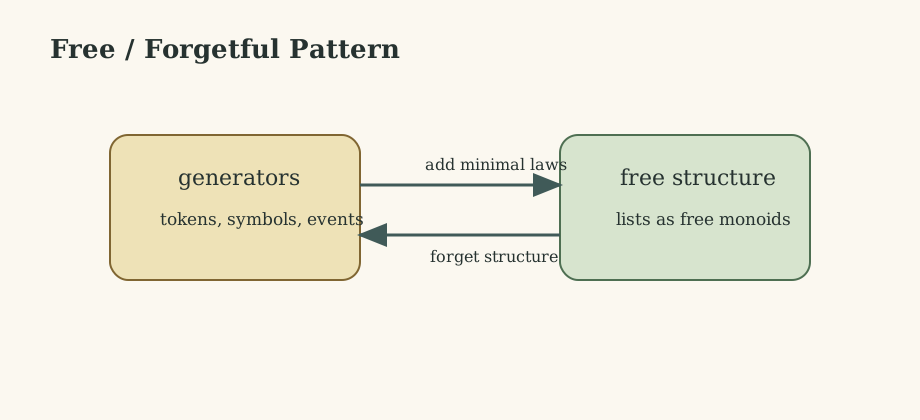
An adjunction relates two functors by a natural isomorphism:
\[\operatorname{Hom}(Fa,b)\cong \operatorname{Hom}(a,Gb).\]Currying is a familiar example. Free and forgetful constructions are another. A forgetful functor removes structure; a free functor adds the minimal structure needed.
Lists are the free monoid on a type. If you know how to interpret one symbol into a monoid, there is a unique way to interpret a whole list by folding. This explains why lists, syntax trees, command logs, and parsers often separate description from interpretation.
6. Monads: Sequencing Context Lawfully
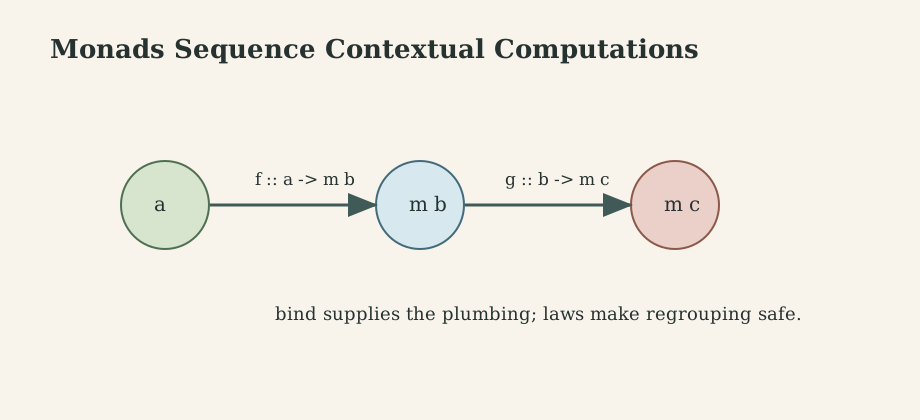
A monad is a functor equipped with enough structure to sequence contextual computations. Programmer-facing operations include:
return :: a -> m a
(>>=)  :: m a -> (a -> m b) -> m b
join   :: m (m a) -> m a
Maybe sequences failure, lists sequence nondeterminism, Reader sequences access to an environment, State sequences state threading, and IO sequences interactions with the external world.
The laws matter because they make refactoring safe. Sequencing should be associative, and return should act like identity. Categorically, a monad is a monoid in the category of endofunctors, with functor composition as the tensor product.
What This Framework Lets Us Do
Category theory helps programmers name reusable structure: composition, data construction, mapping, natural translation, representation, adjunction, and effect sequencing. The payoff is not abstraction for its own sake; it is safer composition of software ideas.
Where the Framework Stops Being Reliable
Real languages include nontermination, exceptions, mutation, compiler details, and runtime effects. Pedagogical categories such as Hask are useful approximations, not perfect mathematical universes. The laws still guide design, but implementations must be tested and documented.
Where the Subject Leads Next
The next steps are applicative functors, monad transformers, profunctors, optics, algebraic effects, denotational semantics, type theory, and categorical logic.
Technical and Editorial Audit
- Condensed a very long chapter-by-chapter essay into a programmer-facing path from composition to monads.
- Preserved Uppsala University reading-group attribution in the main text while avoiding a fabricated course code.
- Added original figures for composition laws, ADTs, Yoneda, adjunctions, and monadic sequencing.
- Kept Haskell snippets short and illustrative rather than exhaustive.
- Clarified the caveat that real programming languages only approximate the clean categorical setting.
Main Sources Used in This Note
- Bartosz Milewski, Category Theory for Programmers.
- Uppsala University public Category Theory for Programmers reading-group page.
- S. Awodey, Category Theory.
- B. C. Pierce, Basic Category Theory for Computer Scientists.