Computational Game Theory- From Formulation to Equilibrium
This note is adapted from course materials for 1MA083 Game Theory at Uppsala University. Instructor: course teaching staff.
Central Question
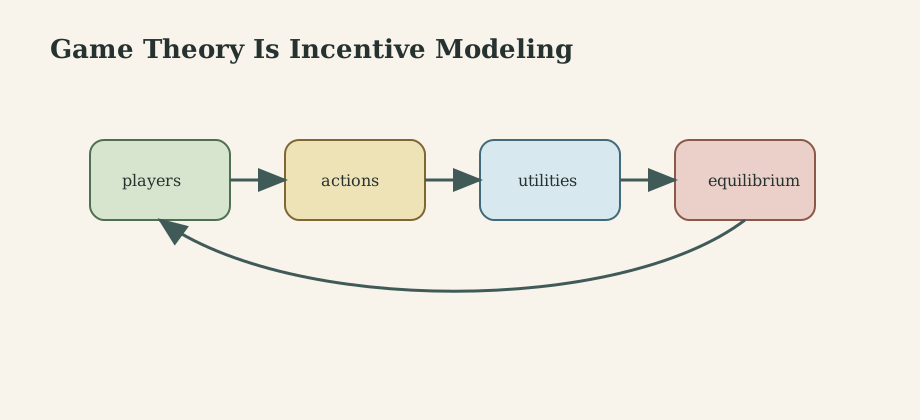
Game theory asks: what outcomes are stable when decision-makers optimize while affecting one another?
A normal-form game is
\[\Gamma=\langle N,(A_i)_{i\in N},(u_i)_{i\in N}\rangle,\]where $N$ is the player set, $A_i$ is player $i$’s action set, and $u_i:A\to\mathbb R$ is the utility function. The modeling burden is in $u_i$: it encodes reward, cost, risk, information, fairness, and incentives.
1. Dominance, Best Response, and Nash Equilibrium
Action $a_i$ is strictly dominated by $a_i’$ if
\[u_i(a_i',a_{-i})>u_i(a_i,a_{-i})\qquad\forall a_{-i}.\]Strictly dominated actions can be eliminated because a rational player never needs them.
Given opponents’ actions, player $i$’s best-response set is
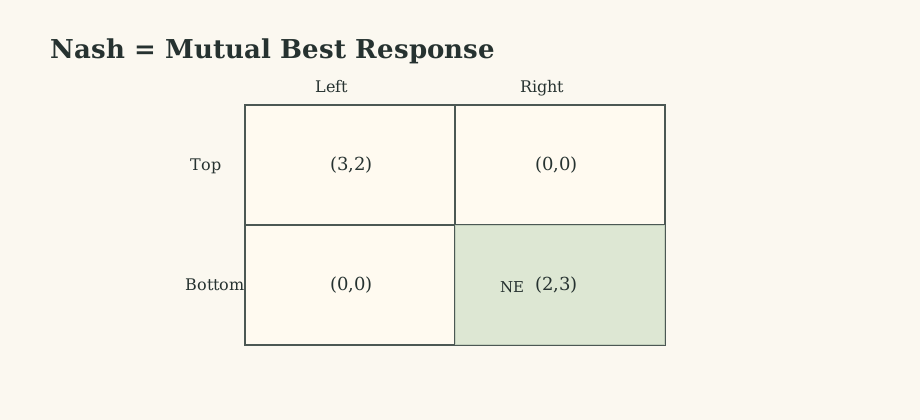
\[BR_i(a_{-i})=\arg\max_{a_i\in A_i}u_i(a_i,a_{-i}).\]A pure Nash equilibrium satisfies
\[a_i^*\in BR_i(a_{-i}^*)\qquad\forall i.\]Equivalently, no player can improve by unilateral deviation. This does not mean the outcome is socially optimal. Prisoner’s Dilemma is the canonical warning: individually stable behavior can be collectively inefficient.
2. Mixed and Correlated Equilibrium
A mixed strategy is a distribution $\sigma_i\in\Delta(A_i)$. Expected utility is
\[U_i(\sigma)=\sum_{a\in A}\left(\prod_j\sigma_j(a_j)\right)u_i(a).\]At a mixed equilibrium, every action in a player’s support yields the same expected payoff. Nash’s theorem guarantees at least one mixed equilibrium in every finite game.
Correlated equilibrium allows a mediator to draw a joint recommendation $a\sim\pi$ and privately recommend $a_i$ to player $i$. The obedience constraints are linear:
\[\sum_{a_{-i}}\pi(a_i,a_{-i}) \left[u_i(a_i,a_{-i})-u_i(a_i',a_{-i})\right]\ge0.\]Correlated equilibria can coordinate better outcomes than independent mixed strategies and can be computed by linear programming.
3. Incomplete Information, Sequential Play, and Repetition
Bayesian games add private types:
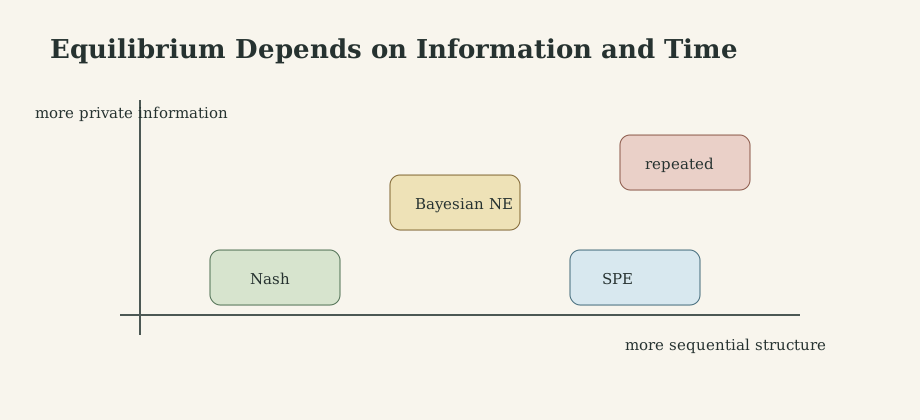
\[\Gamma^B=\langle N,(A_i),(\Theta_i),(u_i),p\rangle.\]A Bayesian Nash equilibrium is a type-contingent strategy profile:
\[s_i^*(\theta_i)\in \arg\max_{a_i} \sum_{\theta_{-i}}p(\theta_{-i}\mid\theta_i) u_i(a_i,s_{-i}^*(\theta_{-i}),\theta_i,\theta_{-i}).\]Extensive-form games model sequential decisions. Subgame-perfect equilibrium removes non-credible threats by requiring Nash equilibrium in every subgame. Backward induction is the key computation in finite perfect-information trees.
Repeated games introduce time and incentives for cooperation. With discount factor $\delta$,
\[V_i=(1-\delta)\sum_{t=0}^{\infty}\delta^t u_i^t.\]In repeated Prisoner’s Dilemma, grim-trigger cooperation can be sustained when future punishment is valuable enough.
4. Potential, Supermodular, and Computationally Friendly Games
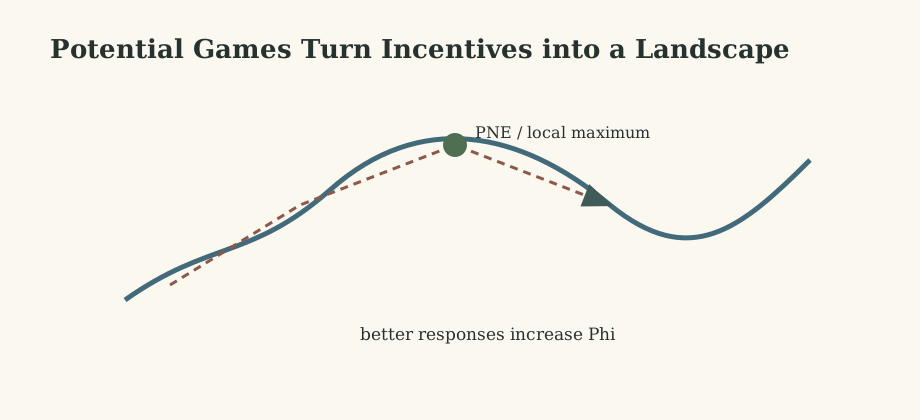
A game has an exact potential function $\Phi$ if unilateral utility changes match potential changes:
\[u_i(a_i',a_{-i})-u_i(a_i,a_{-i}) = \Phi(a_i',a_{-i})-\Phi(a_i,a_{-i}).\]Potential games are computationally attractive because better-response dynamics climb $\Phi$, and maximizers of $\Phi$ are pure Nash equilibria.
Congestion games have Rosenthal’s potential:
\[\Phi(S)=-\sum_{e\in E}\sum_{k=1}^{x_e}c_e(k).\]Supermodular games model strategic complements. Increasing differences imply monotone best responses and useful comparative statics. These structures matter because general equilibrium computation can be hard, but special structure often gives convergence and interpretable algorithms.
5. Mechanism Design and Coalitional Stability
Mechanism design reverses the usual question. Instead of predicting behavior in a fixed game, it designs rules so strategic behavior implements desired outcomes.
For quasi-linear utilities, VCG chooses
\[x^*(\hat\theta)=\arg\max_x\sum_i v_i(x,\hat\theta_i)\]and charges Clarke pivot payments:
\[t_i= \max_x\sum_{j\ne i}v_j(x,\hat\theta_j) - \sum_{j\ne i}v_j(x^*(\hat\theta),\hat\theta_j).\]This makes truthful reporting a dominant strategy under the VCG assumptions.
Coalitional games ask whether groups can profitably deviate. A transferable-utility game is $(N,v)$ with $v:2^N\to\mathbb R$. An allocation is in the core if
\[\sum_{i\in S}x_i\ge v(S)\qquad\forall S\subseteq N.\]The Shapley value allocates payoff by average marginal contribution:
\[\phi_i(v)= \sum_{S\subseteq N\setminus\{i\}} \frac{|S|!(n-|S|-1)!}{n!} \left[v(S\cup\{i\})-v(S)\right].\]6. Learning and Multi-Agent Systems
Fictitious play best-responds to empirical opponent frequencies. No-regret learning guarantees
\[\frac{R_i^T}{T}\to0,\]where
\[R_i^T= \max_{a_i}\sum_{t=1}^T u_i(a_i,a_{-i}^{(t)}) - \sum_{t=1}^T u_i(a_i^{(t)},a_{-i}^{(t)}).\]If all players use no-regret algorithms, time-averaged play converges to coarse correlated equilibrium.
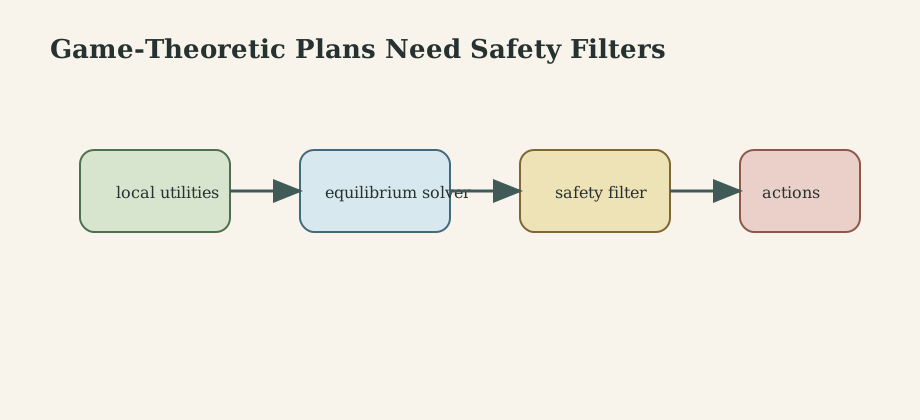
Game theory is useful in multi-agent robotics and distributed systems when autonomy creates coupled incentives: task allocation, path deconfliction, charging schedules, relay assignment, resource sharing, and communication congestion.
What This Framework Lets Us Do
Game theory gives a language for strategic stability, coordination, incentive design, fairness, and decentralized computation. It is especially useful when optimizing one agent in isolation changes the environment seen by others.
Where the Framework Stops Being Reliable
Equilibrium predictions depend on rationality, information, utility design, and the assumed deviation class. A mathematically stable equilibrium can be unfair, unsafe, inefficient, or unreachable by the learning dynamics used in practice.
Where the Subject Leads Next
The next steps are algorithmic game theory, auction design, mean-field games, learning in games, multi-agent reinforcement learning, and mechanism design for autonomous systems.
Technical and Editorial Audit
- Replaced hotlinked Wikimedia images with local original SVG figures.
- Preserved the 1MA083 Uppsala University course attribution in the main text.
- Condensed a long equilibrium survey into a conceptual path from game formulation to equilibria, mechanisms, coalitions, learning, and multi-agent applications.
- Kept core formulas for Nash equilibrium, mixed utility, correlated equilibrium, Bayesian equilibrium, discounting, potential games, VCG, core, Shapley value, and regret.
- The filename typo
Game-Thoeryis preserved to avoid breaking URLs.
Main Sources Used in This Note
- M. J. Osborne and A. Rubinstein, A Course in Game Theory.
- Y. Shoham and K. Leyton-Brown, Multiagent Systems.
- N. Nisan et al., Algorithmic Game Theory.
- D. Fudenberg and J. Tirole, Game Theory.