How to Build Your Retrieval-Augmented Generation (RAG)
This note is adapted from teaching experience in 1DT104 Project in Computer Systems at Uppsala University. Instructor: course teaching staff.
Central Question
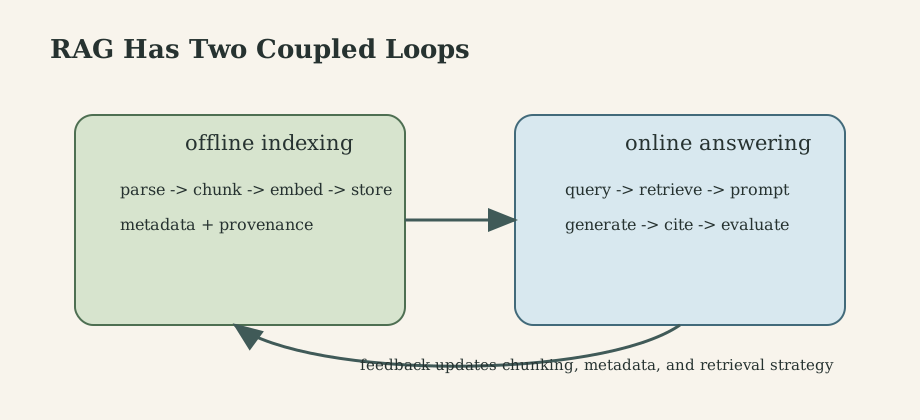
Retrieval-Augmented Generation asks: how can a language model answer with evidence from an external, updateable knowledge source instead of relying only on its parameters?
The basic architecture is simple:
\[\text{RAG}=\text{retrieve relevant context}+\text{generate an answer from that context}.\]The engineering challenge is not the slogan. It is making ingestion, retrieval, prompting, generation, evaluation, and monitoring work together reliably.
1. Why Use RAG?
RAG is useful when knowledge is private, fast-changing, too large for a prompt, or too specific to expect from the base model. It can reduce hallucination risk by grounding responses in retrieved evidence, but it does not eliminate hallucination by itself.
RAG is usually preferable to fine-tuning when the main need is factual access to changing documents. Fine-tuning changes model behavior; retrieval changes the evidence available at inference time. Many production systems use both, but they solve different problems.
The most common failure pattern is retrieval mismatch: the answer is poor because the right evidence never reached the model. That means RAG quality starts before generation.
2. Offline Ingestion: Documents to Searchable Units
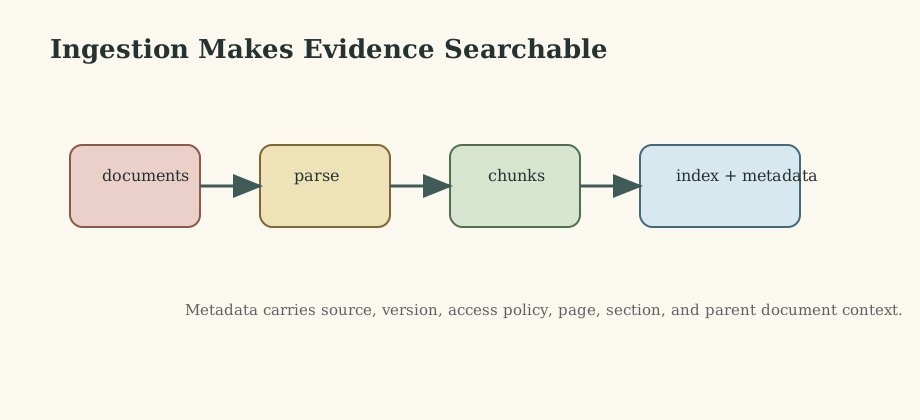
The offline stage converts raw data into indexed evidence:
- collect documents,
- parse text and structure,
- attach metadata,
- chunk into retrievable units,
- embed or index chunks,
- store vectors, sparse terms, and provenance.
Chunking is a modeling choice. A chunk should be small enough to retrieve precisely but large enough to preserve meaning. A document can be partitioned as
\[D=\bigcup_{i=1}^{m}C_i, \qquad |C_i|\le L.\]Useful metadata includes source, section title, timestamp, access policy, document version, page number, and parent-child relationships. Without metadata, retrieval cannot filter, cite, deduplicate, or respect permissions.
3. Retrieval: Dense, Sparse, Hybrid, and Reranked
Dense retrieval maps queries and chunks into vectors:
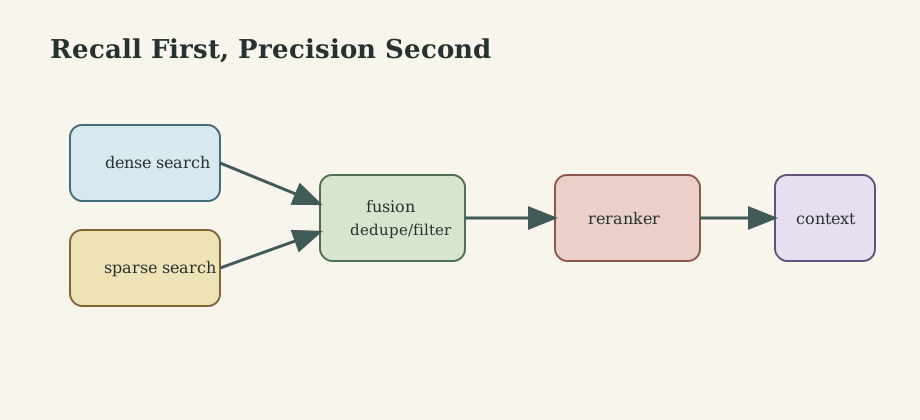
\[\operatorname{sim}(q,c)=\frac{f(q)\cdot f(c)}{\|f(q)\|\|f(c)\|}.\]Sparse retrieval uses keyword or term-frequency signals such as BM25. Dense search handles semantic similarity; sparse search often handles exact names, codes, abbreviations, and rare terms better.
Hybrid retrieval combines both. A common fusion idea is Reciprocal Rank Fusion:
\[\operatorname{score}(d)=\sum_i\frac{1}{k+\operatorname{rank}_i(d)}.\]Reranking then scores the top candidates with a stronger but more expensive model. The retrieval stack is therefore usually staged:
- cheap recall over a large corpus,
- metadata filtering,
- fusion or deduplication,
- reranking,
- context packing.
4. Prompt Assembly and Generation
The prompt should tell the model how to use retrieved evidence. A minimal template is:
Answer the question using the provided context.
If the context is insufficient, say what is missing.
Quote or cite the relevant source ids when possible.

Question:
{user_question}

Context:
{retrieved_chunks}
The model should not be asked to blindly trust context. Retrieved chunks may be outdated, duplicated, irrelevant, or mutually inconsistent. Strong prompts make uncertainty and source conflict explicit.
Context packing is also an optimization problem. Given a context budget, choose passages that maximize coverage and diversity while avoiding repetition. Parent-document expansion, sentence-window retrieval, and section-level summaries can help when the first retrieved chunk is too narrow.
5. Advanced Patterns
Advanced RAG techniques mostly repair one of four weaknesses: query mismatch, corpus mismatch, context overload, or multi-step reasoning.
Useful patterns include:
- multi-query retrieval: generate several search formulations and fuse results,
- query decomposition: split a complex question into subquestions,
- HyDE-style retrieval: generate a hypothetical answer or document and embed it for search,
- parent-child retrieval: search small chunks but return larger parent context,
- routing: choose among vector, keyword, SQL, graph, or API tools,
- graph RAG: retrieve entities and relationships when relational structure matters,
- tool-augmented RAG: combine retrieval with deterministic functions or database calls.
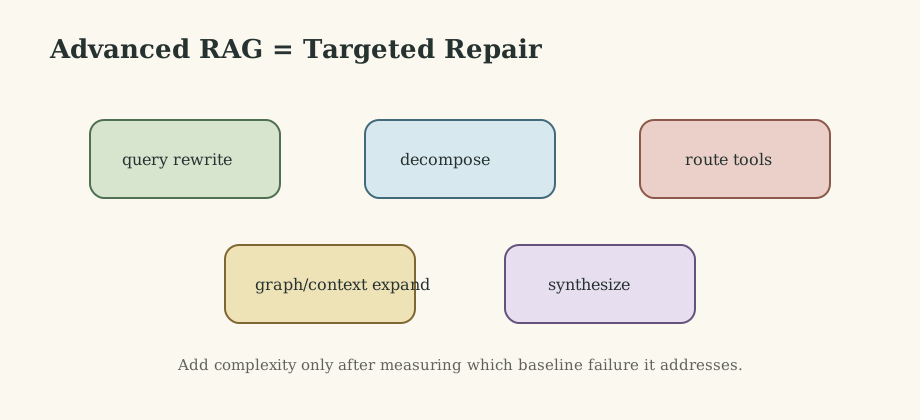
The caution is latency and complexity. Every extra model call can improve quality or simply add cost, variance, and failure modes. Baseline before adding orchestration.
6. Evaluation and Operations
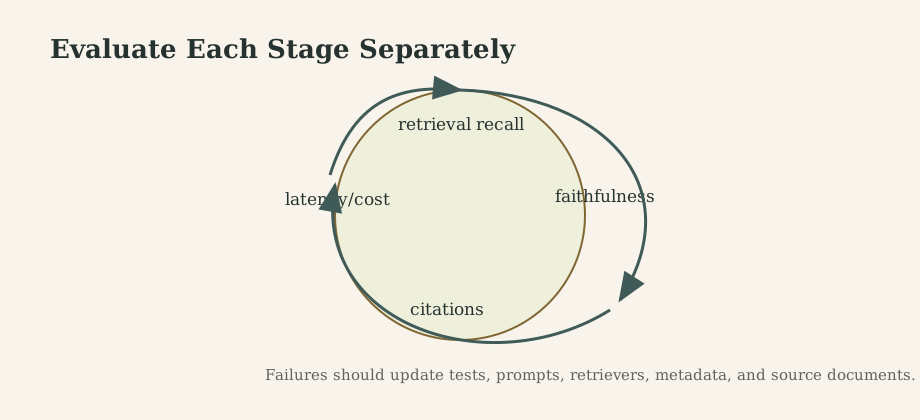
RAG should be evaluated as a pipeline, not only by final answer preference.
Retrieval metrics include:
- Recall@k: did the needed evidence appear?
- Precision@k: how much retrieved context was useful?
- nDCG or MRR: was useful evidence ranked early?
Generation metrics include:
- faithfulness: is the answer supported by context?
- answer relevance: does it address the question?
- citation accuracy: do cited chunks support the claim?
- abstention quality: does the system say “not enough evidence” when appropriate?
Operational checks include latency, cost, index freshness, access control, prompt injection resistance, logging, and drift monitoring.
What This Framework Lets Us Do
RAG lets teams build domain-specific assistants, search interfaces, support bots, documentation copilots, and analysis tools without putting all knowledge into model weights. Its strength is modularity: documents can be updated, retrievers swapped, and evaluation targeted to failure points.
Where the Framework Stops Being Reliable
RAG fails when the corpus lacks the answer, permissions are wrong, retrieval misses evidence, chunks remove necessary context, sources conflict, or the model ignores evidence. It is not a truth machine; it is an evidence-routing architecture.
Where the Subject Leads Next
The next steps are information retrieval, evaluation science, knowledge graphs, agentic tool use, secure document processing, vector indexing, and human-in-the-loop feedback systems.
Technical and Editorial Audit
- Rewrote the post from a tool-list tutorial into a stable architecture guide.
- Preserved the 1DT104 Uppsala University attribution in the main text.
- Removed hotlinked third-party images and replaced them with local original SVG figures.
- Removed brittle version-specific claims about model cutoffs, embedding limits, and recently introduced APIs.
- Kept formulas for chunking, cosine similarity, and rank fusion while emphasizing retrieval and evaluation failure modes.
Main Sources Used in This Note
- P. Lewis et al., “Retrieval-Augmented Generation for Knowledge-Intensive NLP Tasks.”
- J. Lin, X. Ma, S.-C. Lin, J.-H. Yang, R. Pradeep, and R. Nogueira, “Pyserini: A Python Toolkit for Reproducible Information Retrieval Research with Sparse and Dense Representations.”
- N. Thakur et al., “BEIR: A Heterogeneous Benchmark for Zero-shot Evaluation of Information Retrieval Models.”
- G. Izacard et al., “Atlas: Few-shot Learning with Retrieval Augmented Language Models.”
- J. Gao et al., “Retrieval-Augmented Generation for Large Language Models: A Survey.”